
Transitioning to new agricultural models: The potential of beans in water-stressed regions
Esther Camacho · Programs Director
Humberto Vergara · Agronomy Coordinator and Field Solutions Promoter
Braulio Torres · Director of Impact and Learning
March 2023
Agriculture (and food systems) accounts for between 24% and 33% of global greenhouse gas emissions, making it one of the leading economic sectors driving climate change. For this reason, it has become a priority on the agendas of governments and organizations working on climate action.
One of the consequences of climate change is a shift toward less predictable rainfall patterns—and in many cases, simply less rain. This new reality poses a serious challenge for agricultural production. A changing rainfall pattern affects everything from sowing dates and pest management to crop yields per hectare, and it also places immense strain on aquifers. Less rain means less water infiltration. At the same time, higher temperatures increase the water demand of crops. Less rain, more heat, higher crop demand: this leads to greater groundwater extraction and higher aquifer stress. This is happening in Mexico and many other parts of the world. Aquifers are being overexploited. Wells need to be drilled deeper and deeper. In Guanajuato, some are as deep as 200 meters.
In Guanajuato specifically, 84% of the state’s water consumption goes to agriculture. Nineteen out of the twenty aquifers in the state are overexploited. Put another way, the conventional agricultural model is a main reason for the depletion of the state’s water reserves. The deficit in Guanajuato’s aquifers is approximately 1.5 billion cubic meters per year—more water is extracted than is recharged. And there is a physical limit: eventually, the water will run out. This is why Guanajuato is classified as a state under extremely high water stress.
Much of the farmland in Guanajuato is irrigated by flooding, for crops like maize, barley, and wheat. Water is drawn from wells or reservoirs, transported through canals and ditches, and used to flood the fields until the soil is saturated. Unsurprisingly, this is inefficient: up to 60% of the water is wasted, whether because it doesn’t reach the plants, runs off, or evaporates.
This waste explains figures like the 600 liters of water used to produce one kilo of maize. Compare that to onions, which under drip irrigation and proper water management can yield one kilo with just 50 liters. At Nuup, we are working to reduce the water footprint of crops so that more food can be produced with less water. This requires technical assistance, technology, and capital to improve irrigation management and infrastructure. It also requires advancing agricultural practices such as green fertilizers, and rethinking—or remembering—the natural productive vocation of a territory. And here is where we want to highlight the potential of beans.
In 2022, the Nuup team ran a pilot project in Guanajuato with the native ‘vaquita’ bean variety, which commands a premium price in the market. Beans are a crop that requires very little water. We designed this pilot to identify, alongside farmers, new production models that use less water while also making financial sense for them.
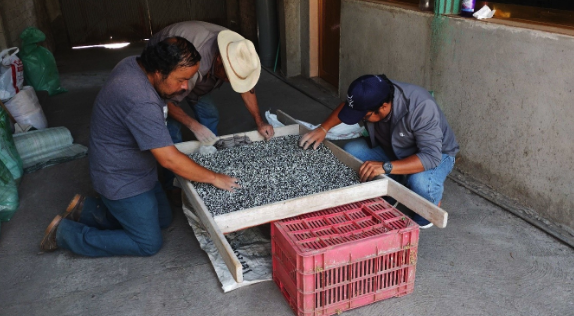
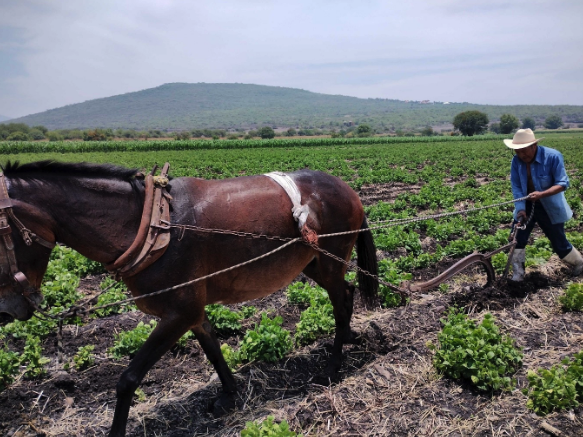
Don O, a farmer from the municipality of Cortázar, planted this bean variety in March last year instead of wheat. Nuup provided four sub-varieties of seed from Zacatecas and Morelos to test their germination and adaptation to the local soil and climate. The beans were planted with minimal preparatory irrigation and then grown under seasonal rainfall, with technical support from the Nuup team.
Fertilizer use was reduced, and organic inputs from our partner Tierra de Monte replaced chemicals for pest management. Our goal is to foster regenerative agricultural practices that build soil health and safeguard long-term productivity.
Throughout the production process, technology and satellite images were used as low-cost, scalable tools to monitor crop health and water demand. The farmer was highly motivated by these tools.
One year later, Don O has chosen to plant beans again—this time on two hectares instead of a quarter hectare—because it proved both feasible and profitable. He also plans to continue using biological products because he saw that “they give the beans strength.” Through this experience, he has become more conscious of water issues and has decided to upgrade parts of his farm with drip irrigation. He knows irrigation will help him adapt to climate variability. At Nuup, this reinforces our belief that transitioning to new agricultural models is possible: models that are more biodiverse, have a smaller water footprint, and create prosperity for farmers.
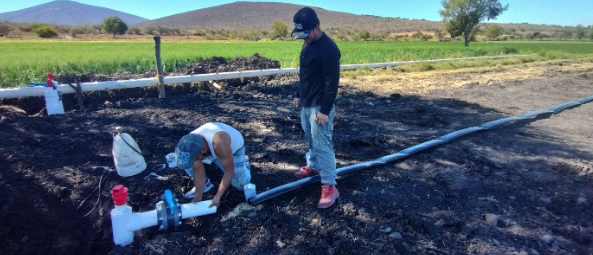
A secure market connection is key to making this transition. In this project, we partnered with La Comandanta, a buyer that values native seeds and sustainable practices. They guaranteed the purchase of the harvest, which encouraged Don O to try a different crop. A secure market makes it easier to change habits for farmers who have cultivated the same crops in the same way their whole lives.
Some regions in Mexico urgently need a radical shift in their production paradigm. The water crisis facing many territories is a wake-up call to rethink our agriculture and our food consumption. In a country where 51% of the land is arid or semi-arid, it seems obvious to promote nutritious crops that use less water.
For example, if farmers in Guanajuato shifted from wheat to beans on just 50,000 hectares (about 5% of the state’s agricultural land), it could save up to 175 million cubic meters of water in aquifers. This is equivalent to the annual water consumption of 1.3 million people.
At Nuup, we believe that new production models are possible—models that fit the context of each territory. We are dedicated to developing and scaling fair, profitable, and planet-conscious agricultural models, always tied to innovative commercialization strategies. We know that transitioning to new production models is easier when they are both environmentally sustainable and economically viable. Beans and other alternative, underutilized crops, together with financial and technical support and access to formal markets, can be part of the solution to the water crisis that we are already facing, even if it is difficult to see.